
17th Annual General Meeting of DPinet Nepal held: Earthquake early warning system and emphasis on local level capacity development


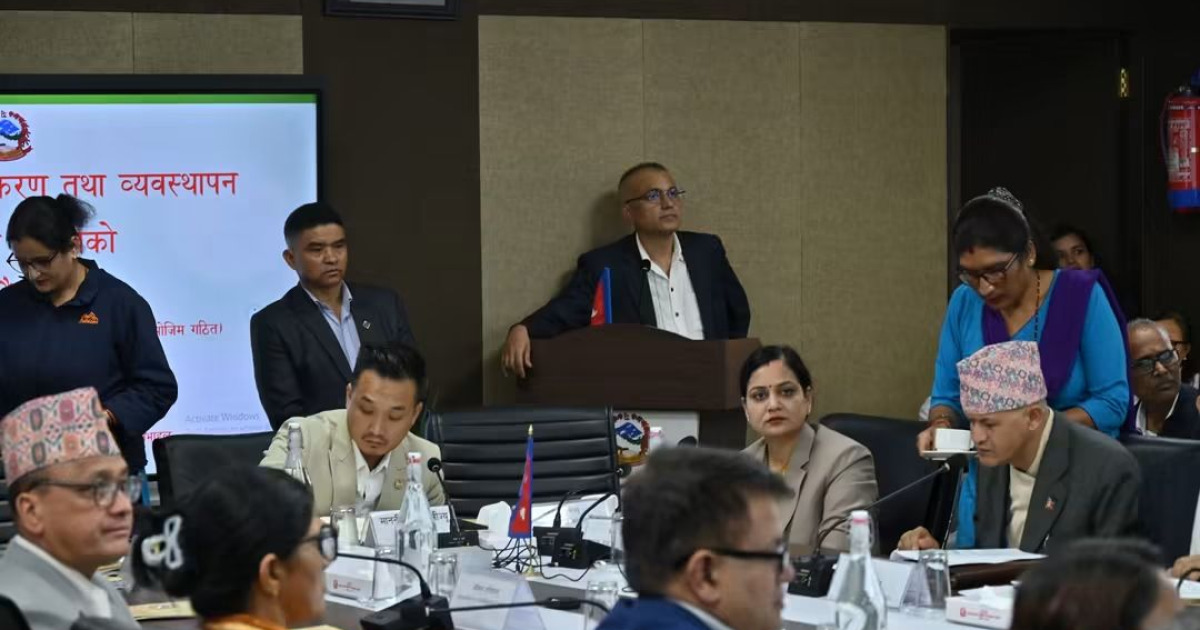
Kathmandu, 20 January. NDRRMA Executive Chief Dr. Dinesh Prasad Bhatta said that damage reduction would be possible if the local level is empowered. He informed that a separate ‘Disaster Code’ related to disasters is needed and initiatives are being taken to expand access to the ‘Loss and Damage Fund’.
This view was expressed at the inauguration program of the 17th Annual General Meeting of Disaster Preparedness Network Nepal (DPNET).
The general meeting was chaired by DPNET President Dr. Raju Thapa, while National Disaster Risk Reduction and Management Authority (NDRRMA) Executive Chief Dr. Dinesh Prasad Bhatta was present as the chief guest.
The welcome address was delivered by Vice President Gurung, while the program was conducted by General Secretary E. Suraj Gautam.
The proposed program for the current fiscal year 2082/83 was presented in the general meeting, approving the annual program for the fiscal year 2081/82. The meeting reminded the participants of the fact that DPNET has been contributing to disaster risk reduction and management by expanding coordination, collaboration and partnership between national and international organizations, government agencies and various stakeholders.
Established as an informal forum in 2052 BS and duly registered at the District Administration Office, Kathmandu in 2064 BS, DPNET has been active in the field of disaster risk reduction for the past 29 years. Currently, the network has 191 members, including national and international organizations, individual and life members.
Earthquake Early Warning System Indispensable
Technical Advisor Bishal Nath Upreti, while giving a presentation on ‘Earthquakes in Nepal: Early Warning System’ at the general meeting, said that the risk of major earthquakes remains in the Himalayan region. According to him, studies have shown the possibility of an earthquake of magnitude 8.5 like the one in 1505 BS. Although there are currently 47 seismic stations and 11 GPS stations in Nepal, this number is insufficient for effective early warning of major earthquakes, he said.
“Developing technology that can provide information 40 seconds in advance could save more than one million lives,” he said. However, he noted that Nepal is still at risk due to lack of access to the necessary technology and data.
Role of local levels and security agencies
Disaster expert Shankar Koirala emphasized the need to make municipalities and provinces efficient in disaster management. He said that the Ministry of Home Affairs should take the lead in ensuring uniformity in training and access to the general public.
NSET Nepal Executive Director Surya Narayan Shrestha informed that Earthquake Safety Day has been celebrated since 1995 and this year marks the 21st edition. He also said that the ‘Asia Conference on Engineering’ will be organized in Nepal in the context of the tenth anniversary of the Gorkha earthquake in May.
Disaster Management Award Presentation
The ‘Disaster Management Award’ was presented to three people who have made significant contributions to the field of disaster management at the assembly. The awardees include Arun Sainju, Shriram Sharma and Dodhara Chandani Municipality Mayor Kishore Kumar Limbu.
Kedar Neupane, coordinator of the award committee and former secretary, pointed out the need to arrange special honors and awards, stating that the state has not yet given enough encouragement to those working in the disaster area.
At the program, DPNET Chairman Dr. Raju Thapa expressed concern over the government's lack of seriousness in implementing the early warning system. "Despite the Supreme Court's directive, the expected progress in the early warning system has not been made," he said. He concluded that the need of the day was to provide a separate budget and make the NDRRMA more active.
More from NewaTimes



Comments (0)
No comments yet
Be the first to comment!
Write a Comment